


CTE Curriculum
Prepare learners with CTE curriculum aligned to industry standards.


1. Before You Begin
New to certification testing on the iCEV Testing Platform? Work through this checklist before instruction begins. Links point to the full detail further down the page.
- Confirm your iCEV account access. Log in and make sure you can see the Course Library. Some settings require an organization administrator. iCEV Customer Support can assign one.
- Add your certification course. Add the certification course to your My Courses page. Returning users: clear last year's roster or start a fresh course to pick up updated content.
- Roster your students. Invite students by iCEV login, through your LMS (LTI) integration (like Clever or Classlink ) or automatically by SIS-integrated LMS rostering.
- Decide on the Diagnostic Pretest. Enable it before students access the curriculum. Once enabled, pretesting cannot be turned off for that course. The Diagnostic Pretest is designed to be taken only once and before any curriculum is seen. It allows for identification of knowledge gaps and growth over time. See Administer the Diagnostic Pretest .
- Map your testing window. Use the Pacing Guide to total your instruction days, then count back from the last possible test date, reserving time for remediation and retakes. See Pacing Guide .
- Check your voucher balance. Every exam attempt uses a voucher. Confirm you have enough in your account well before test day. See Accommodations, Vouchers & Digital Badging .
- Submit accommodation requests. Due at least two business days before testing for students with IEPs, 504 plans, medical needs, or English Language Learner status. See Accommodations, Vouchers & Digital Badging .
- Enable digital badging. Credly must be enabled once by an organization administrator so earners may receive shareable digital badges. See Accommodations, Vouchers & Digital Badging .
- Assign and prepare your proctor. Plan for one proctor per 30 students. Proctors must review the proctoring guidelines before administering the exam. See Administer the Certification Exam .
2. Understand How Certifications Are Designed
Industry certifications exist to validate that an individual possesses the knowledge and skills required for success in a specific career field. Because employers and industries define workforce expectations, each certification begins with the organization that owns and awards the credential.
Many industry-leading organizations have deep expertise in their field but are not equipped to build, deliver, secure, and maintain a large-scale certification testing program. The iCEV Testing Platform serves as the delivery partner by hosting and managing industry certifications on behalf of these organizations while also providing optional certification preparation materials designed specifically to prepare learners for certification success.
Every certification begins with a set of industry standards established by the certifying agency. These standards define the knowledge and skills a successful candidate should demonstrate. Working alongside subject-matter experts from the certifying organization, iCEV translates those standards into measurable learning objectives that become the foundation for the certification preparation materials.
Industry standards reflect current workforce expectations and are periodically updated as those expectations change. Most certifying agencies formally review and update industry standards on a recurring cycle, typically every three years, to ensure certifications continue to reflect current industry practices, technologies, regulations, and employer expectations.
Find the industry certifications approved in your state: icevonline.com/state-resources
From Industry Standards to Certification Success
Every industry certification hosted on the iCEV Testing Platform follows the same intentional development process:
- The certifying organization identifies the industry standards.
- iCEV and industry experts translate those standards into measurable learning objectives.
- Certification preparation materials are developed to teach those objectives.
- The certification exam measures mastery of the industry standards.
- Performance data and industry feedback help inform future revisions.
Although every certification is unique, they all follow this same instructional design framework.
Example: Ducks Unlimited Ecology Conservation & Management Certification
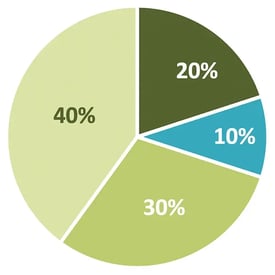
The Ducks Unlimited Ecology Conservation & Management Certification was developed in collaboration with Ducks Unlimited's Chief Scientist and other ecology experts. Together, Ducks Unlimited and iCEV identified the knowledge and skills expected of professionals entering the field and organized them into four major industry standards:
- Ecological Principles (20%)
- Habitat Conservation & Management (40%)
- Wildlife Conservation & Management (30%)
- Species Identification (10%)
These standards define what the certification measures. They are not individual lessons. They represent the competencies students are expected to demonstrate on the certification exam.
How Certification Prep Materials Are Built
Certification preparation materials are intentionally designed around the industry standards measured by the certification. Every lesson, activity, assessment, and instructional resource exists for one purpose: helping students build the knowledge and skills needed to earn an industry certification.
Rather than teaching concepts once and moving on, certification preparation follows a research-based instructional progression. Learners encounter important concepts multiple times throughout the course as they move from learning a concept to applying it in authentic situations.
Throughout a certification course, students will:
- Build foundational knowledge through multimedia lessons developed with industry experts.
- Reinforce learning through vocabulary, activities, projects, and both formative and summative assessments.
- Apply concepts in new contexts across multiple lessons.
- Measure progress through the Diagnostic Pretest and lesson assessments.
- Review and practice before attempting the certification exam.
Because certification success depends on mastery, not memorization, important concepts are intentionally revisited throughout the course.
Note: All certification pretests and certification exams must be completed directly within the iCEV platform. These exams cannot be imported into or taken through your district's LMS (LTI).
How Industry Standards & iCEV Lessons Work Together
Each industry standard is broken into learning objectives or key skill areas, and each skill area is matched to a lesson (or lessons) that help build the related knowledge. The Relative Emphasis column shows what share of that topic area's exam questions are supported by each lesson, based on an internal mapping of every exam question to its source lesson. It reflects proportion, not question count or wording, so the underlying exam content stays secure.
A Real Example: Industry Standards & iCEV Lessons
| Industry Standard | % of Exam | # Questions |
|---|---|---|
| Ecological Principles | 20% | 20 |
| Habitat Conservation & Management | 40% | 40 |
| Species Identification | 10% | 10 |
| Wildlife Conservation & Management | 30% | 30 |
1. Ecological Principles
Covers defining ecosystems and ecological succession and evaluating methods of monitoring and sustaining ecosystems.
| Lesson(s) | Relative Emphasis |
|---|---|
| Ecological Principles | Primary, 75% |
| Forests: Conservation and Management | Supporting, 15% |
| Grasslands: Conservation and Management | Supporting, 10% |
Most of this standard is built directly in the Ecological Principles lesson. However, a meaningful share of these questions is answered using concepts taught inside the Forests and Grasslands lessons, where ecological principles are applied to real habitat examples.
2. Species Identification
Covers identifying wildlife by taxonomic grouping, recognizing distinguishing characteristics, and using identification resources.
| Lesson(s) | Relative Emphasis |
|---|---|
| Species Identification | Primary, 100% |
This is the most self-contained standard in the certification: one lesson builds the entire standard, making it the most straightforward to plan for and assess.
3. Wildlife Conservation & Management
Covers the North American Model of Wildlife Conservation, wildlife management techniques, wildlife population ecology, and waterfowl ecology, conservation, and management.
| Lesson(s) | Relative Emphasis |
|---|---|
| The North American Model of Wildlife Conservation | 20% |
| Wildlife Management | 20% |
| Wildlife Population Ecology | 17% |
| Waterfowl: Conservation and Management | 20% |
| Waterfowl Ecology | 23% |
This standard maps cleanly to five lessons of roughly equal weight (17 to 23% each), meaning consistent, even coverage of all five lessons is the most reliable way to prepare students for this standard.
4. Habitat Conservation & Management
Covers the principles of habitat conservation, and the ecology, importance, threats, and management of forests, grasslands, and wetlands (including wetland goods and services).
| Lesson(s) | Relative Emphasis |
|---|---|
| Principles of Habitat Conservation and Management | 20% |
| Forests: Conservation and Management | 22% |
| Grasslands: Conservation and Management | 18% |
| Wetlands: Conservation and Management | 20% |
| Wetlands: Ecosystem Goods & Services | 20% |
As the largest standard on the exam, this domain draws evenly from five lessons. Because it carries 40% of total exam weight, even a small drop in coverage of any one of these lessons has an outsized effect on overall student performance.
3. Administer the Diagnostic Pretest
Benefits, Enabling Diagnostic Pretests & Reports
What Is Diagnostic Pretesting?
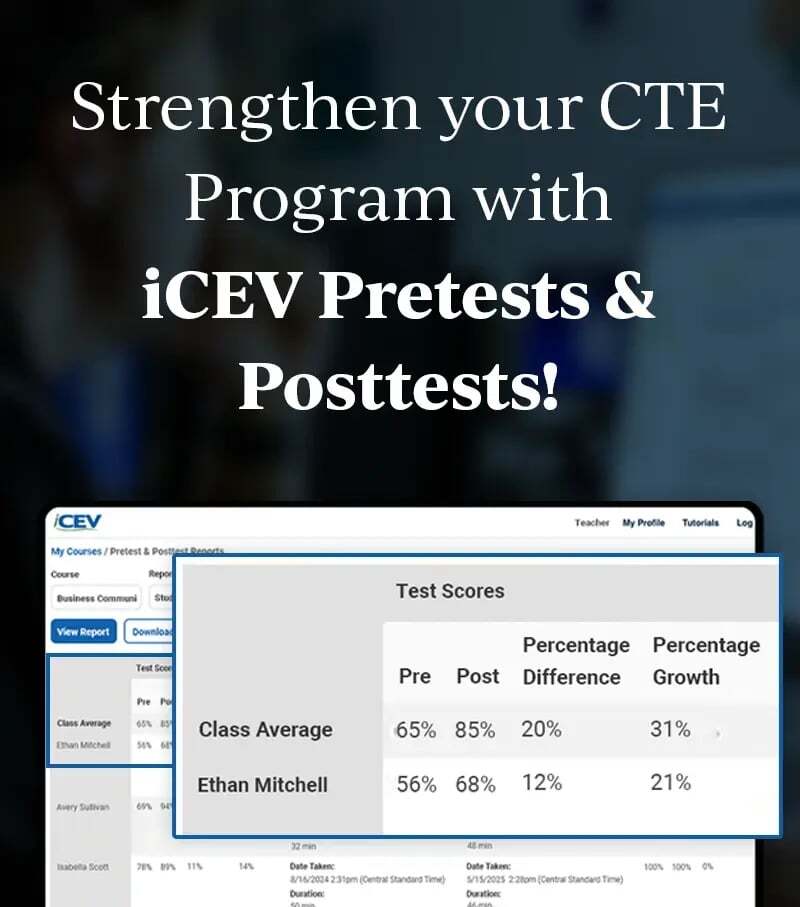
iCEV offers complimentary Diagnostic Pretests that allow for measurement of student readiness before instruction. Diagnostic Pretests provide a snapshot of what students know before instruction, helping teachers target learning where it's needed most.
Teachers may enable a pretest before students access the certification curriculum. The pretest assesses current knowledge and enables growth reporting for students and classes. Growth values never go below zero.
Important: Once enabled, pretesting cannot be turned off.
Benefits
- Measure baseline knowledge before instruction begins
- Identify student strengths and learning gaps
- Guide instruction with actionable data
- Support personalized learning from day one
Enabling Diagnostic Pretests
Under Settings (right side of the screen):
- Click Enable Pretests.
- Wait for the pop-up window.
- Check Yes, enable pretests for this certification course.
- Click Enable.
- You'll see: "Pretests have been successfully enabled."
New students: If a new student joins a course with pretesting enabled, they must complete the pretest before accessing the curriculum.
Canceling the Process
Click in the shaded area of the dialog, press Esc, or click the red X. After enabling, the status and date that the pretest was enabled will appear under Settings.
Pretest Reports
With pretesting enabled, additional information is available in the Industry Certification Reports dashboard:
- Pretest scoring information
- Certification scoring information (if completed)
- Growth (difference between Certification and Pretest scores)
- Lowest possible value is 0
4. Teach with iCEV Lessons
Lesson Design & Lesson Plans
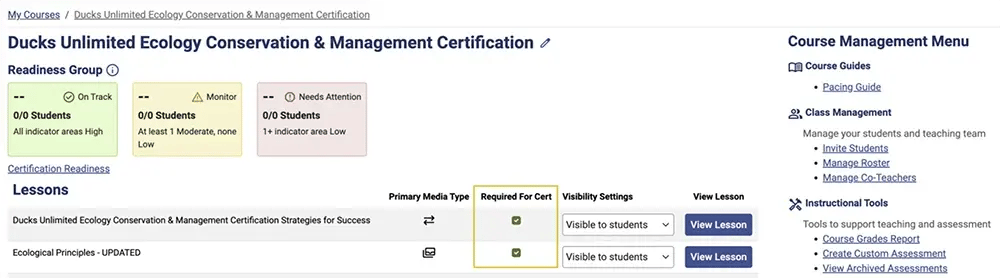
The default setting requires students to achieve at least 70% on lesson final assessments before a certification exam is unlocked. While instructors can override this setting, iCEV recommends using the Certification Readiness Indicator to guide testing decisions.
Lesson Plan
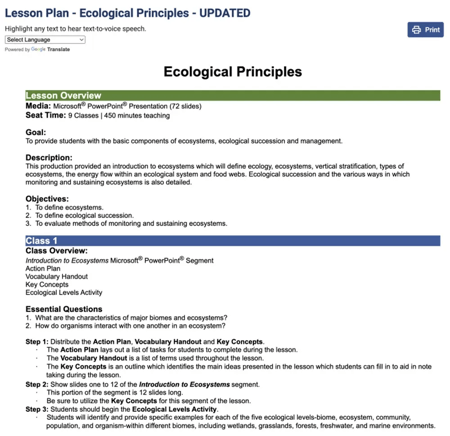 Each lesson plan includes:
- Media Type (PowerPoint or Video)
- Seat Time (number of classes based on 50-minute class periods)
- Goal, Description, and Objectives for the lesson
- Class Period Breakdowns
- Class Overviews with Essential Questions and Step-by-Step Instructions
- Project and Activity Overviews with Accommodations, Modifications, Extensions, and a Supply List
- CTSO Connections
- Career Connections
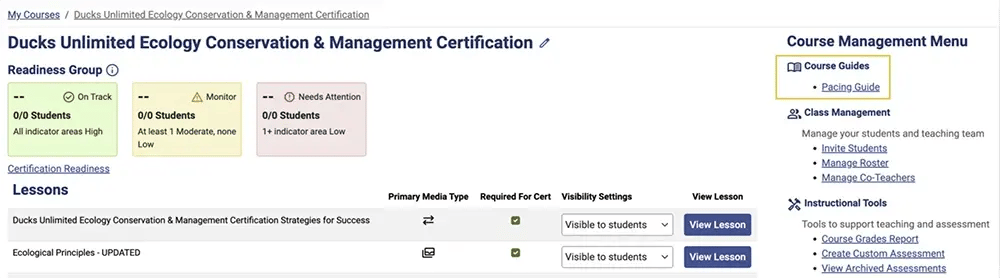
Pacing Guide
The Pacing Guide is intended to serve as a planning resource rather than a prescribed instructional schedule. Estimated instructional days are based on implementing the complete lesson plan as written. Actual pacing will vary based on district requirements, instructional models, class schedules, student readiness, and individual classroom implementation. Teachers are encouraged to adjust pacing to best meet the needs of their students while ensuring all industry standards are adequately covered before certification testing.
Use the Pacing Guide to identify the estimated number of instructional days required to complete the iCEV lesson plans. When planning your certification testing schedule, begin with the last possible testing date for the school year. Consider reserving this date for the final retake opportunity you intend to offer. Then, work backward by:
- Reserving time between testing attempts for remediation and additional instruction, if needed.
- Allowing sufficient instructional days to complete the lessons and adequately prepare students for certification testing.
This backward-planning approach helps ensure students receive the full instructional experience while allowing time for remediation and multiple testing opportunities, if your testing plan includes them.
Lesson Components
Multimedia Assets (PowerPoint and/or Video)
Created in collaboration with industry experts, these provide consistent instruction through videos and presentations aligned to certification standards.
Projects
Provide authentic opportunities for students to apply certification concepts in real-world scenarios.
Activities
Reinforce knowledge through guided practice and skill application.
Vocabulary
Industry certifications include technical language that students must understand and apply.
Check for Understanding
Provide immediate feedback and help verify mastery before students advance.
Key Concepts
Represent the essential knowledge and skills measured on the certification exam.
Final Assessments
Frequent assessments measure learning progress and identify areas that need reinforcement before the certification exam.
Creating Custom Practice Tests
If you'd like to test students quarterly or over the lessons they struggled most with on the pretest, use the custom assessment tool to create your own practice tests.
Review Lesson
Includes a comprehensive PowerPoint and practice tests that familiarize students with certification-style questions, identify remaining gaps, and build confidence before the exam.
Assignment Visibility Settings
Manage lesson and activity visibility settings in iCEV so you can control exactly what your students see and when they see it. Best practices for using these components:
-
Attempt Threshold: If this is left blank, students have unlimited opportunities to complete the assignment.
Best Practice: Limit this to one to start, then increase it if needed, after every student has completed the assignment at least once, for any potential remediation or accommodations.
-
Show Correct Answers after Submission: If students are allowed to view the correct answers and are given multiple attempts, they may complete the assignments consecutively by relying on memorization rather than demonstrating genuine content mastery. As a result, the assessment data may inaccurately reflect their true understanding of the material and limit its effectiveness as a measure of learning.
Best Practice: Leave this unchecked unless needed for remediation or accommodations.
-
Show Question Feedback: This should be used with discretion since it could create the same situation as Show Correct Answers mentioned above.
-
Visible to Student: When this is checked, students will be able to see the assignment(s) in their accounts.
Best Practice: Make assignments visible to students as you assign them to prevent overwhelming students by making all assignments visible at one time.
-
Show on Grade Report: When checked, this will show the Student Grade Report at the top of the lesson page. When unchecked, students will still be able to complete the assignment; however, it will not be visible on the grade report.
-
Deactivate Assignment on Date: This optional feature allows for specification of a date and time after which the assignment will no longer be available for your students to complete.
Lab Challenges
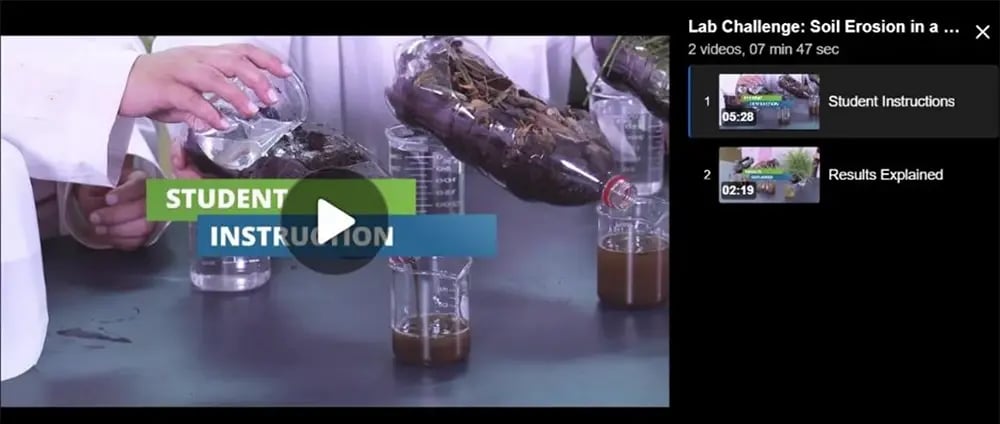
For additional hands-on learning opportunities, you may be interested in creating a customized course and adding the lab challenges related to the certification you are using.
Example
iCEV's Wildlife, Fisheries, & Ecology Management course includes the following lab challenges, all of which are a great fit for the Ducks Unlimited Ecology Conservation & Management Certification:
- Water Cycle
- Soil Erosion in a Bottle
- Wetland in a Pan
5. Monitor Certification Readiness
Using the Certification Readiness Indicator
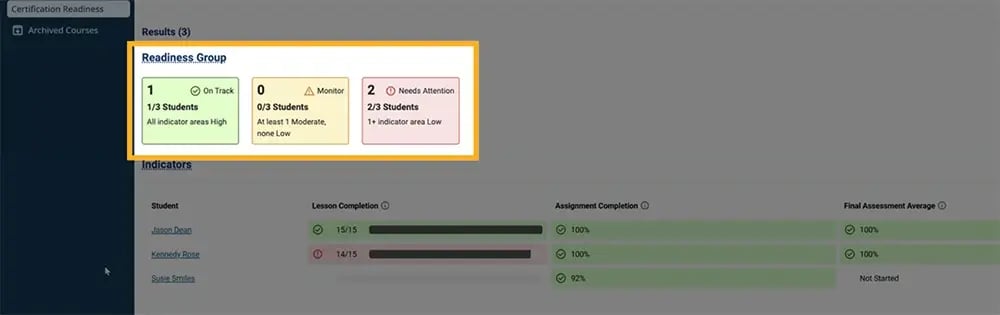
iCEV's Certification Readiness Indicator gives educators instant visibility into how students are progressing toward certification success. All instructional materials are meaningful, but after an internal study of those who passed a certification on their first attempt, the following came back as the best predictors for readiness:
- Lesson Completion
- Assignment Completion
- Final Assessment Average
- Practice Exam
Use the Certification Readiness Indicator for a clear, data-based view of student progress toward industry certifications, grouping students by readiness and highlighting where extra support is needed.
Accessing Certification Readiness Through the Reports Menu
- Open Reports from the main navigation menu, select Certification Readiness from the options that appear, choose your course, then click View Report to access your class data.
- On a certification-aligned course page, select the Certification Readiness link below the Readiness Group summary. This opens the same readiness report for the class connected to that course.
6. Before Certification Testing
Accommodations, Vouchers & Digital Badging
Accommodations
Submit accommodation requests at least two business days before testing for those with IEPs, 504 plans, medical needs, or English Language Learner status.
Vouchers
Each attempt at a certification exam will require a certification voucher. Be sure you have enough vouchers in your account before administering the certification exam to your class. Additional vouchers can be purchased by contacting Customer Support . Check your balances in your iCEV account.
Enable Digital Badging
Credly must be enabled once by an organization administrator. If an iCEV account does not have an organization administrator, one can be requested through Customer Support .
What to Know Before Proctoring
- Students can flag questions to revisit
- Students can review all questions before submitting the exam, which will help prevent accidentally skipped questions
- Timed at 2 hours unless time and a half is a previously approved accommodation
- 100 multiple-choice questions
- Results will be provided immediately
- Cut score: 70%
- Available in Spanish and English
- The number of years a certification remains valid varies by certification
- Multiple attempts are offered at the organization's discretion
Important: When testing in an educational setting, district personnel may serve as proctors as long as they have read and agreed to the proctor rules and guidelines and meet local and state requirements for proctoring. Before proctoring a certification exam, the proctor must read and digitally sign the proctor agreement to ensure all rules and guidelines will be followed during the certification exam.
7. Administer the Certification Exam
Proctor Requirements & Best Practices
Proctors must review and agree to testing guidelines prior to administration. In preparation for testing, review the proctoring guidelines and script to prepare for your responsibilities.
- Assign a proctor if you don't plan to proctor the exam yourself.
Note: We recommend one proctor per 30 students.
If multiple proctors will be administering the certification exam to students within the same course, consider creating a unique test session for each proctor.
Best Practices:
- Create a course for each proctor on each test day
- The course could be named "Proctor Name, Test Date, Test Name"
- Uncheck Required For Cert on each lesson in the course to bypass default requirements
Steps to Proctoring
Step 1: Select Certification
From the My Courses page, both the proctor and the student should click View next to the certification.
Proctoring for more than one certification exam: The proctor page supports one exam per page for performance. To oversee multiple certifications, open each exam in its own browser tab or window (right-click the proctor button, then choose "Open link in new tab").
Step 2: Manage Proctors
Teacher View: Proctor the Exam
- Scroll to the bottom of the Lessons page.
- Under Proctors:
- Click Manage Proctors if you will not be proctoring the exam yourself, or
- Click Proctor Exam to proctor yourself.
Student View: Confirm Identity
Once a student is ready to take a certification exam, they should:
- Locate the Final Assessment at the bottom of the Lessons page.
- Confirm their identity by checking the box and clicking the green Check In button.
- The exam status will read: "Waiting on Proctor to start the exam."
More information: Proctoring Guidelines
Step 3: Checking In
Status: Not Checked-In
If a student is ready but hasn't checked in, you'll see a "Not Checked-In" message. Ask the student to check in; once the student has checked in, the status will change to "Ready". The floating timer shows when you last refreshed the proctor page. If a candidate says they've checked in but you don't see them, click "Refresh Now".
Status: Ready
"Ready" means the student completed required lessons and has checked in.
Exam Language column
With the Spanish language option available for select certification exams, the proctor page includes an Exam Language column that shows the language of each student's exam.
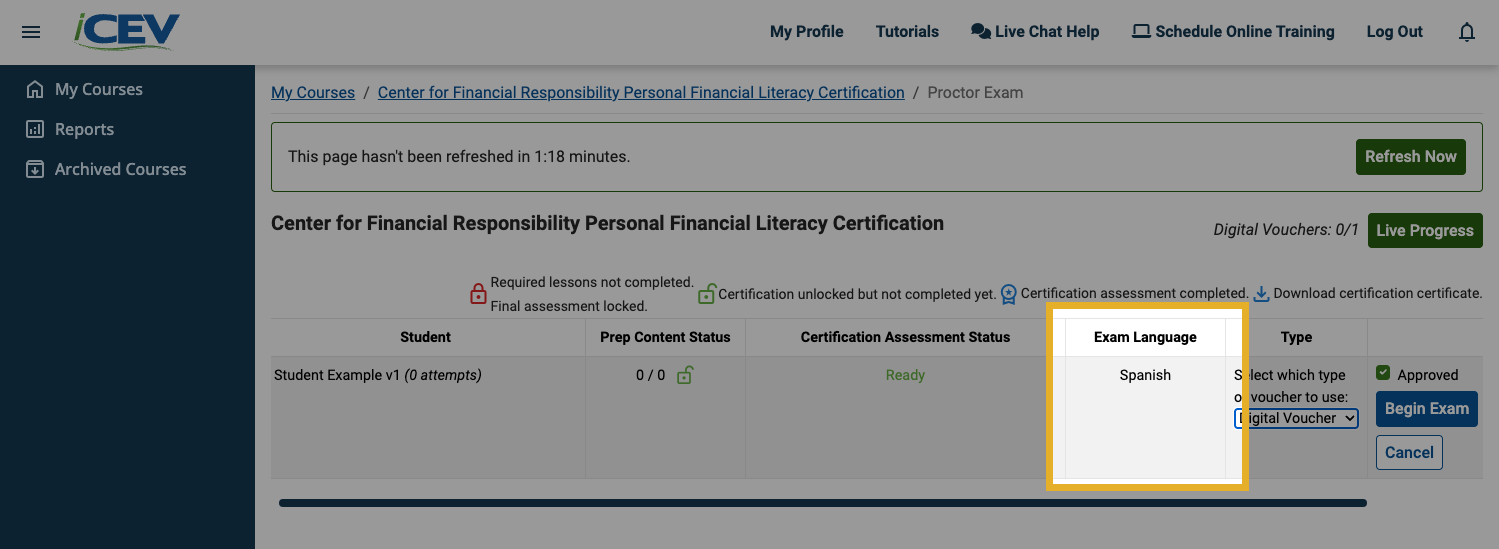
Status: Select which type of voucher to use
-
Digital Voucher. A digital version of the manual voucher codes. When selected, the student will be sent directly into the exam. This is the most popular voucher choice among school districts.
- Select Digital Voucher (selected by default).
- Click the Approved checkbox.
- Click Begin Exam.
-
Voucher Code. Enter a manual voucher code directly from the Proctor Exams screen:
- Select Voucher Code from the dropdown.
- Enter the voucher code in the textbox.
- Click the Approved checkbox.
- Click Begin Exam.
-
Student Entry. Sends the student to a manual voucher or credit card payment screen. After submission, they proceed to the exam.
Troubleshooting
If a student was set to use a manual voucher but was taken to a "Select Method of Payment" screen when starting the final certification exam, it happened because either:
- The voucher code was invalid, or
- The voucher code was previously used.
Step 4: Monitoring Progress
Note: Students must begin their certification exam within 20 minutes of proctor approval. If they fail to do so, they will receive a notification informing them that their session will be terminated.

Understanding the Live Progress Screen Icons
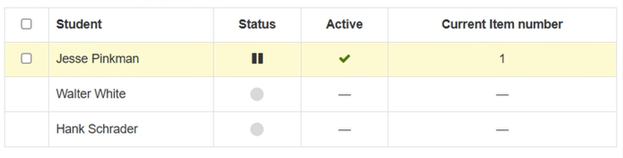
The Live Progress screen includes visual indicators to help proctors monitor student activity in real time.
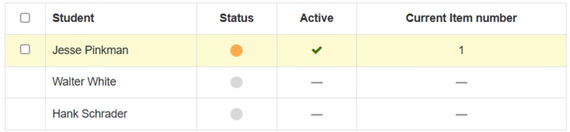
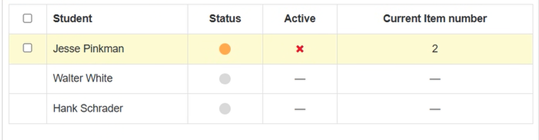
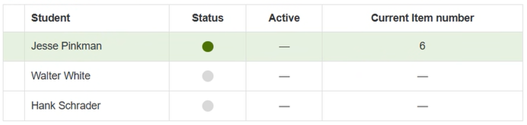
Active Column
- ✓ Green Check Mark – Student is actively working in the iCEV exam window.
- ✕ Red X – Student clicked outside the iCEV exam window and may be accessing something else.
- — Dash – Exam has been submitted.
Status Column
- ⏸ Pause Icon – Question review pop‑up is open.
- Orange Dot – Exam is currently active.
- Green Dot – Exam has been submitted.
Step 5: Resetting
Important: The reset button appears only after a candidate checks back in following a technical issue that disrupted testing.
How the reset works: Proctors can reset a student's attempt up to three times per student per certification. Resets prevent consuming a digital voucher or code when:
- Testing device loses power or network connectivity
- Student closes the browser or tab, or navigates to a different website
Note: Students with 70 or more correct answers at disruption will pass and won't restart. Students with more than 30 incorrect answers at disruption will not have a reset option.
8. Review Certification Reports
Gain valuable insights into certification performance with detailed reports designed to support data-driven decisions. View key metrics such as the number of students certified, total test attempts, pass rates, average test time, grades, and frequently missed industry standards.
These insights help you pinpoint strengths, uncover learning gaps, and refine instruction, empowering you to provide targeted support and improve student success on certification exams.
- Consider growth reporting for those who passed the certification on their first attempt.
- Consider the Industry Standards Report for those who need remediation.
Viewing Student Certification Reports
Step 1: Go to Reports
- From any page on the iCEV Platform, use the left-hand navigation to click Reports.
- Select Student Certifications from the expanded options.
Step 2: View Reports
You'll see a report for each certification attempted by your students, including:
- Certified: total students who earned the certification
- Attempts: total exam attempts
- Passing: pass rate percentage
- AVG Time: average time on the exam
- AVG Grade: average exam grade
- Industry Standard Reports: class average of correct answers for each industry standard
Note: Reports with an eye icon in the top right corner can be clicked on to view individualized student reports. This is where teachers can download spreadsheet versions of the reports.
Step 3: View Certification Summary Report
- Click the Certification Summary Report icon.
- A new tab opens to the Student Certification Summary page.
- Select a Certification Report from the dropdown, then click View Report.
- A report is generated for each student.
Step 4: View Assessment Attempts
- If lessons were required to be completed before attempting the exam, click the ratio (#/#) next to a student's name to view progress and assessment scores (opens in a new tab).
- To view the students' progress for a different certification, select a different certification from the Certification drop-down menu.
Student Certification Reporting
Choose which students appear in the Student Certification Report.
- Show Current Students: Shows students currently in the iCEV roster (default).
- Show Previous Students: Shows students not currently in the iCEV roster (applies to certification courses reused without deletion).
- Show All Students: Shows both current and previous students.
Student Certification Reporting: Industry Standards Report
See how students scored compared to the class average and to each other.
- Click Industry Standard Reports.
- Open the Report Type dropdown and select Student.
Report Types
- Student: Individual performance by standard alongside class average.
- Class: Overall class performance (original report format).
Score Modes
- Percentage (default): Shows the overall percentage performance of the student in the different certification standard areas.
- Points (select to view): Shows the overall points performance of the student in the different certification standard areas.
9. Celebrate & Market Earner Success
Certificates, Digital Badges & #HireCertified
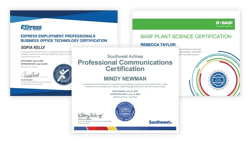
Digital Certificates: Educators can download digital certificates on demand from an iCEV account.
Printed Certificates: iCEV prints and ships paper certificates to earners' schools.
 Certification Wall Mounts: Schools with 10 or more certification earners in a school year are eligible for a wall mount from iCEV. Be on the lookout for your opt-in invitation once you've reached 10 earners.
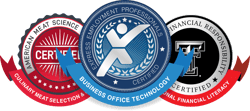
Digital Badges: Encourage earners to share their digital badge in electronic resumes, email signatures, and on social media. Each badge contains verifiable metadata documenting earned competencies. iCEV's digital badge distributor, Credly , connects earned badges to labor market data and careers.
Educators Certify Free: Research from iCEV shows that 63.8% of teachers saw higher student pass rates after earning the certification themselves. See how it works.

10. Support & Resources
You are not on your own. Use these contacts and resources any time before, during, or after testing.
Customer Support
- Email: customersupport@icevonline.com
- Phone: 800-922-9965 (toll-free)
- Live chat: available on-demand from any page of the iCEV Platform
- Reach out for: account access, organization administrator requests, voucher purchases and balances, accommodation requests, and exam-day issues such as exam reset.
Self-Service Resources
- Learning Center: icevonline.com/learning-center for tutorials, guides, and how-to articles for the platform.
- Certification hub: icevonline.com/certifications for certification lists, exam details, and preparation materials.
- Digital badging: support.credly.com for badge claiming and account questions.
Before You Call
Have your certification name, course name, and the student's name ready. It speeds up voucher, accommodation, and reset requests considerably.